Madhyamik Physical Science 2017

Complete Question Paper with Detailed Solutions & Explanations

Question Paper: 2017
Reading Time: 15-20 mins
Class: X (Madhyamik)
Subject: Physical Science

About This Solution Guide

Welcome to the complete solution guide for Madhyamik 2017 Physical Science question paper! This resource is designed to help Class 10 students understand concepts thoroughly, not just memorize answers.

Each solution includes detailed explanations to ensure you grasp the underlying principles. Whether you're preparing for exams or revising concepts, this guide will be your perfect companion.

Key Features

  • Complete question paper coverage
  • Step-by-step solutions
  • Concept explanations
  • Interactive question navigation
  • Mobile-friendly design
15
MCQ Questions (1 Mark Each)
21
Very Short Questions (1 Mark Each)
9
Short Questions (2 Marks Each)
12
Long Questions (3 Marks Each)

📝 Exam Preparation Tip

Focus on understanding concepts rather than memorizing answers. This approach will help you tackle similar questions even if they're framed differently in your exam.

GROUP-A: MCQ Questions

1.1 Which among the following is not a greenhouse gas?
(a) methane
(b) water vapour
(c) carbon dioxide
(d) oxygen
Answer: (d) oxygen
Explanation: Greenhouse gases trap heat in the atmosphere. Methane, water vapor, and carbon dioxide are all greenhouse gases. Oxygen is not a greenhouse gas as it does not absorb infrared radiation effectively.
Concept: Greenhouse Effect
1.2 Which of the following is the SI unit of pressure?
(a) Nm\(^2\)
(b) Nm\(^3\)
(c) Nm
(d) N
Answer: (a) Nm\(^2\)
Explanation: Pressure \( P = \dfrac{F}{A} \). So SI unit = \( \mathrm{N/m^2} \) = \( \mathrm{Nm}^{-2} \), also called the Pascal (\( \text{Pa} \)).
Concept: Pressure & Units
1.3 If the vapour density of a gas is 32, which among the following is its molecular weight?
(a) 8
(b) 16
(c) 32
(d) 64
Answer: (d) 64
Explanation: Molecular weight = 2 × Vapour density. So, Molecular weight = 2 × 32 = 64.
Concept: Vapour Density
1.4 On which of the following does the thermal conductivity of a metal depend?
(a) temperature
(b) length
(c) nature of the material
(d) area of the cross-section
Answer: (c) nature of the material
Explanation: Thermal conductivity is an intrinsic property of a material and depends on the nature of the material itself, not on its dimensions.
Concept: Thermal Conductivity
1.5 What is the relation between the radius of curvature and the focal length of a mirror?
a. f=2r
b. f=r/2
c. f=r/3
d. f=(2/3) r
Answer: b. f=r/2
Explanation: For spherical mirrors, the focal length (f) is half of the radius of curvature (r). So, f = r/2.
Concept: Spherical Mirrors
1.6 Which of the following colours deviates most when white light is refracted by a prism?
(a) red
(b) yellow
(c) violet
(d) green
Answer: (c) violet
Explanation: Violet light has the shortest wavelength and highest refractive index, so it deviates the most when passing through a prism.
Concept: Dispersion of Light
1.7 Which of the given physical quantities represents ampere?
(a) coulomb-second
(b) volt-ohm\(^{-1}\)
(c) volt-ohm
(d) volt\(^2\)-ohm
Answer: (b) volt-ohm\(^{-1}\)
Explanation: According to Ohm's law, V = IR, so I = V/R = V·Ω\(^{-1}\). Therefore, ampere can be represented as volt-ohm\(^{-1}\).
Concept: Electric Current
1.8 Resistivity of which of the following decreases with increase in temperature?
(a) conductor
(b) semiconductor
(c) superconductor
(d) insulator
Answer: (b) semiconductor
Explanation: In semiconductors, resistivity decreases with increasing temperature because more charge carriers become available for conduction as temperature rises.
Concept: Electrical Resistivity
1.9 Which of the following is the correct order of ionising power for \( \alpha \), \( \beta \) and \( \gamma \) rays?
(a) \( \alpha > \beta > \gamma \)
(b) \( \alpha > \gamma > \beta \)
(c) \( \gamma > \beta > \alpha \)
(d) \( \beta > \alpha > \gamma \)
Answer: (a) \( \alpha > \beta > \gamma \)
Explanation: Alpha particles have the highest ionizing power due to their large mass and charge, followed by beta particles. Gamma rays have the least ionizing power.
Concept: Radioactivity
1.10 Which of the following has the highest atomic radius?
(a) K
(b) H
(c) Li
(d) Na
Answer: (a) K
Explanation: Potassium (K) has the highest atomic radius among these elements. In the periodic table, atomic radius increases down a group, and K is below Na and Li in Group 1.
Concept: Periodic Properties
1.11 In which of the following is a covalent bond present?
(a) hydrogen chloride
(b) sodium chloride
(c) lithium hydride
(d) calcium oxide
Answer: (a) hydrogen chloride
Explanation: Hydrogen chloride (HCl) has a covalent bond where electrons are shared between hydrogen and chlorine atoms. The other compounds are ionic in nature.
Concept: Chemical Bonding
1.12 Which of the following is a weak electrolyte in aqueous solution?
(a) CH\(_3\)COOH
(b) NaOH
(c) H\(_2\)SO\(_4\)
(d) NaCl
Answer: (a) CH\(_3\)COOH
Explanation: Acetic acid (CH\(_3\)COOH) is a weak electrolyte as it only partially ionizes in aqueous solution. The others are strong electrolytes that completely dissociate.
Concept: Electrolytes
1.13 Which of the following is used to dry moist ammonia?
(a) conc. H\(_2\)SO\(_4\)
(b) P\(_2\)O\(_5\)
(c) CaO
(d) CaCl\(_x\)
Answer: (c) CaO
Explanation: Quicklime (CaO) is used to dry ammonia gas as it does not react with ammonia. Concentrated H\(_2\)SO\(_4\) reacts with ammonia, and P\(_2\)O\(_5\) is deliquescent.
Concept: Drying Agents
1.14 Which of the following is an ore of aluminium?
(a) bauxite
(b) haematite
(c) malachite
(d) chalcopyrites
Answer: (a) bauxite
Explanation: Bauxite (Al\(_2\)O\(_3\)·2H\(_2\)O) is the principal ore of aluminium. Haematite is an ore of iron, malachite of copper, and chalcopyrites is also a copper ore.
Concept: Metallurgy
1.15 Which of the following is the functional group of aldehydes?
a. -OH
b. -CHO
c. -COOH
d. =CO
Answer: b. -CHO
Explanation: The functional group of aldehydes is -CHO (aldehyde group). -OH is for alcohols, -COOH for carboxylic acids, and -CO- for ketones.
Concept: Organic Chemistry

GROUP-B: Short Answer Questions

2.1 Fill in the blanks: In troposphere temperature ______ with increase in altitude.
Answer: decreases
Explanation: In the troposphere, temperature decreases with altitude at an average rate of 6.5°C per kilometer.
Concept: Atmospheric Science
2.1 (or) Mention one harmful effect of global warming.
Answer: Melting of polar ice caps/rise in sea level
Explanation: Global warming causes melting of glaciers and polar ice, leading to rising sea levels.
Concept: Atmospheric Science
2.2 Which atom, released from a chlorofluorocarbon under the influence of UV rays, decomposes ozone into oxygen?
Answer: Chlorine atom (Cl)
Explanation: Chlorofluorocarbons (CFCs) release chlorine atoms when broken down by UV radiation. These chlorine atoms catalyze the decomposition of ozone (O\(_3\)) into oxygen (O\(_2\)).
Concept: Ozone Depletion
2.3 Write whether the following statement is true of false: Under the same condition of temperature and pressure equal volumes of CO\(_2\) and N\(_2\) gas contain a different number of molecules.
Answer: False
Explanation: According to Avogadro's law, equal volumes of all gases under the same conditions of temperature and pressure contain the same number of molecules.
Concept: Gas Laws
2.4 Write down the relation between the pressure and volume of a given mass of a gas, according to Boyle's law when temperature remains constant.
Answer: P ∝ 1/V or PV = constant
Explanation: Boyle's law states that for a fixed amount of gas at constant temperature, the pressure (P) is inversely proportional to the volume (V). Mathematically, P ∝ 1/V or PV = constant.
Concept: Boyle's Law
2.5 Between the apparent and real expansion coefficients of a liquid, which one is its own characteristic?
Answer: Real expansion coefficient
Explanation: The real expansion coefficient is the characteristic property of a liquid as it accounts for the actual expansion of the liquid itself, independent of the container.
Concept: Thermal Expansion
2.5 (or) What is the SI unit of thermal conductivity?
Answer: W m\(^{-1}\) K\(^{-1}\)
Explanation: The SI unit of thermal conductivity is watt per meter per kelvin (W m\(^{-1}\) K\(^{-1}\)).
Concept: Thermal Expansion
2.6 Give a natural example of dispersion of light.
Answer: Rainbow
Explanation: A rainbow is a natural example of dispersion of light. It occurs when sunlight is refracted, reflected, and dispersed by water droplets in the atmosphere, separating white light into its constituent colors.
Concept: Dispersion of Light
2.7 Which type of lens can be used to rectify myopic vision?
Answer: Concave lens
Explanation: Myopia (nearsightedness) is corrected using concave (diverging) lenses. These lenses help to diverge light before it enters the eye, allowing the image to focus properly on the retina.
Concept: Human Eye & Vision
2.8 What will be the change in the motion of a Barlow's wheel if the direction of the current is reversed?
Answer: The direction of rotation will reverse
Explanation: Barlow's wheel demonstrates the motor effect. When the direction of current is reversed, the direction of the magnetic force also reverses according to Fleming's left-hand rule, causing the wheel to rotate in the opposite direction.
Concept: Electromagnetism
2.9 How much work has to be done when 1 coulomb of charge is taken against a potential difference of 1 volt?
Answer: 1 joule
Explanation: Work done (W) = Charge (Q) × Potential difference (V). So, W = 1 C × 1 V = 1 J. Therefore, 1 joule of work is done.
Concept: Electrical Work
2.10 From which part of a radioactive atom is a \( \beta \)- particle emitted?
Answer: From the nucleus
Explanation: Beta particles are emitted from the nucleus when a neutron transforms into a proton.
Concept: Radioactive Decay
2.10 (or) What is the atomic number of the daughter element produced if an \( \alpha \)-particle is emitted from \( ^{238}_{92} \text{U} \)?
Answer: 90
Explanation: For alpha decay: \( ^{238}_{92} \text{U} \rightarrow ^{234}_{90} \text{Th} + ^4_2\alpha \), so the atomic number of the daughter element is 90.
Concept: Radioactive Decay
2.11 Match the right column with the left column
Left Column Right Column
2.11.1 A transition element (a) Aluminium
2.11.2 A transuranium element (b) Nickel
2.11.3 Reduces Fe\(_2\)O\(_3\) at high temperature in the thermit process (c) Tin
2.11.4 Present in the alloy bell metal (d) Plutonium
Answer:
Left Column Right Column
2.11.1 A transition element (b) Nickel
2.11.2 A transuranium element (d) Plutonium
2.11.3 Reduces Fe\(_2\)O\(_3\) at high temperature in the thermit process (a) Aluminium
2.11.4 Present in the alloy bell metal (c) Tin

Explanation:
• Nickel is a transition element (d-block element)
• Plutonium is a transuranium element (atomic number > 92)
• Aluminium reduces iron oxide in thermit process: \( 2\text{Al} + \text{Fe}_2\text{O}_3 \rightarrow 2\text{Fe} + \text{Al}_2\text{O}_3 \)
• Bell metal is an alloy of copper and tin
Concept: Elements & Compounds
2.12 Draw Lewis dot diagram of F\(_2\) molecule. (F=9)
Answer: :F ─ F: with 3 lone pairs on each F
Explanation:
Fluorine atom (atomic number 9) has electronic configuration: 2,7
It needs 1 electron to complete its octet
In F\(_2\) molecule, two fluorine atoms share one pair of electrons
Lewis structure: :F ─ F:
Each fluorine atom has 3 lone pairs (6 electrons) and 1 shared pair (2 electrons)
Concept: Chemical Bonding
2.13 Why is the electrical conductivity of the solution produced by adding little sulphuric acid into pure water more than the electrical conductivity of pure water?
Answer: Due to ionization.
Explanation: Pure water has very low electrical conductivity because it has very few ions. When sulphuric acid is added, it ionizes to produce H\(^+\) and SO\(_4^{2-}\) ions, which act as charge carriers, increasing conductivity.
Concept: Electrolytes & Conductivity
2.13 (or) What are the carriers of electricity in the solution during the electrolysis of aqueous solution of an electrolyte?
Answer: Ions
Explanation: During electrolysis, the carriers of electricity are ions - cations (positive ions) move towards cathode and anions (negative ions) move towards anode.
Concept: Electrolytes & Conductivity
2.14 Which ion migrates towards the cathode during the electrolysis of an aqueous solution of CuSO\(_4\), using Cu electrodes?
Answer: Cu\(^{2+}\) ions
Explanation: During electrolysis of CuSO\(_4\) solution with copper electrodes:
• Cu\(^{2+}\) ions (cations) migrate towards cathode
• At cathode: Cu\(^{2+}\) + 2e\(^-\) → Cu (copper deposition)
• SO\(_4^{2-}\) ions (anions) migrate towards anode
• At anode: Cu → Cu\(^{2+}\) + 2e\(^-\) (copper dissolution)
Concept: Electrolysis
2.15 Write down the formula of the black precipitate formed when H\(_2\)S gas is passed through an aqueous solution of lead nitrate.
Answer: PbS
Explanation: When H\(_2\)S is passed through lead nitrate solution:
Pb(NO\(_3\))\(_2\) + H\(_2\)S → PbS ↓ + 2HNO\(_3\)
Black precipitate of lead sulfide (PbS) is formed.
Concept: Chemical Reactions
2.15 (or) What changes of colour is observed when H\(_2\)S gas is passed through an acidified aqueous solution of potassium dichromate?
Answer: Orange to green
Explanation: When H\(_2\)S is passed through acidified K\(_2\)Cr\(_2\)O\(_7\) solution:
Orange color of dichromate (Cr\(_2\)O\(_7^{2-}\)) changes to green color of chromium(III) ions (Cr\(^{3+}\)).
K\(_2\)Cr\(_2\)O\(_7\) + 4H\(_2\)SO\(_4\) + 3H\(_2\)S → K\(_2\)SO\(_4\) + Cr\(_2\)(SO\(_4\))\(_3\) + 7H\(_2\)O + 3S
Concept: Chemical Reactions
2.16 Two substances are used in the production of urea. One is ammonia, what is the other?
Answer: Carbon dioxide (CO\(_2\))
Explanation: Urea is produced by the reaction between ammonia and carbon dioxide:
2NH\(_3\) + CO\(_2\) → NH\(_2\)CONH\(_2\) + H\(_2\)O
This reaction occurs under high pressure (150-250 atm) and temperature (180-200°C).
Concept: Industrial Chemistry
2.17 Mention one use of poly (vinyl chloride).
Answer: Making pipes, cables, flooring, etc.
Explanation: Polyvinyl chloride (PVC) is used for:
• Water pipes and plumbing fittings
• Electrical cable insulation
• Flooring materials
• Window frames
• Medical devices
• Packaging materials
Concept: Polymers
2.18 Write down the IUPAC name of CH\(_3\)CH\(_2\)CH\(_2\)OH.
Answer: Propan-1-ol
Explanation: CH\(_3\)CH\(_2\)CH\(_2\)OH has 3 carbon atoms with -OH group on terminal carbon, so IUPAC name is Propan-1-ol.
Concept: Organic Chemistry
2.18 (or) Write down the constitutional formula of an isomer of CH\(_3\)CH\(_2\)OH.
Answer: CH\(_3\)-O-CH\(_3\)
Explanation:CH\(_3\)CH\(_2\)OH is ethanol (C\(_2\)H\(_6\)O). Its isomer is dimethyl ether: CH\(_3\)-O-CH\(_3\)
Both have same molecular formula C\(_2\)H\(_6\)O but different functional groups (alcohol vs ether).
Concept: Organic Chemistry

GROUP-C: Short Answer Questions

3.1 What is meant by calorific value of a fuel? Between coal and diesel, which has greater calorific value?
Answer: Diesel has greater calorific value than coal
Calorific value is the amount of heat energy produced on complete combustion of a unit mass of fuel. It is usually expressed in kJ/kg. Diesel has a higher calorific value (approx. 45,500 kJ/kg) compared to coal (approx. 25,000-33,000 kJ/kg).
Concept: Fuels & Calorific Value
3.2 If the volume of a given mass of a gas at STP is 52 m³, what will be its volume at the pressure of 104 cmHg temperature remaining constant?
Answer: 38 m³
Solution:
Using Boyle's law: \( P_1V_1 = P_2V_2 \)
At STP, P₁ = 76 cmHg, V₁ = 52 m³
P₂ = 104 cmHg
\( V_2 = \frac{P_1V_1}{P_2} = \frac{76 \times 52}{104} = 38 \) m³

Concept: Gas Laws
3.2 (or) What will be the volume of 8g of \( H_2 \) gas (H=1) at the pressure of 4 atmosphere and temperature of 300K? (R= 0.082 litre atmosphere mol\(^{-1}\) K\(^{-1}\))
Answer: 24.6 litres.
Solution:
Using ideal gas equation: \( PV = nRT \)
Molar mass of H₂ = 2 g/mol
Number of moles, \( n = \frac{8}{2} = 4 \) moles
\( V = \frac{nRT}{P} = \frac{4 \times 0.082 \times 300}{4} = 24.6 \) litres

Concept: Gas Laws
3.3 How does the refractive index of a medium depend on the velocity of light?
Answer: \( \mu = \frac{c}{v} \)
Refractive index \( \mu \) of a medium is inversely proportional to the velocity of light in that medium. \( \mu = \frac{c}{v} \), where c is speed of light in vacuum and v is speed of light in the medium.
Concept: Optics
3.3 (or) What kind of mirror is used in the headlight of a car and why?
Answer: Concave mirror
Reason: Concave mirrors are used in car headlights because they are converging mirrors that can produce a powerful, parallel beam of light when the light source is placed at their focus.
Concept: Optics
3.4 Mention two advantages of using a CFL lamp over an incandescent lamp?
Answer: 1. Higher efficiency 2. Longer lifespan
Explanation:
1. Higher efficiency: CFLs convert about 20-25% of electrical energy into visible light, while incandescent bulbs convert only about 5%.
2. Longer lifespan: CFLs last 8-15 times longer than incandescent bulbs (approx. 8000 hours vs 1000 hours).
Additional advantages: Lower heat generation, energy saving, cost-effective in long run.
Concept: Electrical Appliances
3.5 An aqueous solution of sugar cannot conduct electricity, but an aqueous solution of sodium chloride can. Why?
Answer:
Sugar (C₁₂H₂₂O₁₁) is a covalent compound that doesn't ionize in water, so it cannot conduct electricity. Sodium chloride (NaCl) is an ionic compound that dissociates into Na⁺ and Cl⁻ ions in water, allowing conduction of electricity.
Concept: Electrolytes & Chemical Bonding
3.5 (or) Why is it appropriate to use the term formula weight instead of molecular weight in case of sodium chloride?
Answer:
Sodium chloride is an ionic compound, not a molecule. It exists as a crystal lattice of ions, so we use the term "formula weight" (mass of one formula unit) rather than "molecular weight" (mass of one molecule).
Concept: Electrolytes & Chemical Bonding
3.6 Compare the following two properties of naphthalene and sodium chloride: melting point and solubility in water.
Answer: NaCl has higher melting point and is soluble in water; Naphthalene has lower melting point and is insoluble
Explanation:
Melting point: Sodium chloride has a high melting point (801°C) due to strong ionic bonds. Naphthalene has a lower melting point (80°C) due to weaker intermolecular forces.

Solubility in water: Sodium chloride is highly soluble in water due to ion-dipole interactions. Naphthalene is insoluble in water as it is non-polar and cannot form hydrogen bonds with water.
Concept: Physical Properties of Compounds
3.7 Name a gas which can be prepared in Kipp's apparatus. Write the balanced chemical equation of the reaction for the preparation of the gas.
Answer:
First Part: Hydrogen sulfide (H₂S) gas.

Second Part Kipp's apparatus is used to prepare gases by the action of a liquid on a solid. Hydrogen sulfide can be prepared by the action of dilute HCl on iron sulfide:
\( \text{FeS} + 2\text{HCl} \rightarrow \text{FeCl}_2 + \text{H}_2\text{S} \uparrow \)

Note: Other gases that can be prepared in Kipp's apparatus: CO₂ (using marble chips and HCl), H₂ (using zinc and HCl).
Concept: Laboratory Preparation of Gases
3.8 How is metallic zinc obtained from zinc oxide? Write the reaction with a balanced chemical equation.
Answer:
Zinc oxide is reduced to zinc metal by heating with carbon:
\( 2\text{ZnO} + \text{C} \rightarrow 2\text{Zn} + \text{CO}_2 \)
Concept: Metallurgy & Redox Reactions
3.8 (or) What happens when a piece of zinc is added to an aqueous solution of CuSO₄? Show with the help of electronic theory that this is an oxidation-reduction reaction.
Answer:
When zinc is added to CuSO₄ solution:
\( \text{Zn} + \text{CuSO}_4 \rightarrow \text{ZnSO}_4 + \text{Cu} \)

According to electronic theory:
- Zinc loses 2 electrons: \( \text{Zn} \rightarrow \text{Zn}^{2+} + 2e^- \) (Oxidation)
- Copper gains 2 electrons: \( \text{Cu}^{2+} + 2e^- \rightarrow \text{Cu} \) (Reduction)
This is a redox reaction where zinc is oxidized and copper is reduced.
Concept: Metallurgy & Redox Reactions
3.9 Show with the help of structural formula of ethylene that it is an unsaturated hydrocarbon.
Answer:
Ethylene (C₂H₄) has the structural formula:
H₂C=CH₂
The presence of a carbon-carbon double bond makes it unsaturated. Unsaturated hydrocarbons have double or triple bonds and can undergo addition reactions.
Concept: Organic Chemistry
3.9 (or) What is a denatured spirit?
Answer:
Denatured spirit is ethanol that has been made unfit for drinking by adding poisonous substances like methanol, pyridine, or copper sulfate. It is used as a solvent and fuel, and is exempt from liquor taxes.
Concept: Organic Chemistry

GROUP-D: Long Answer Questions

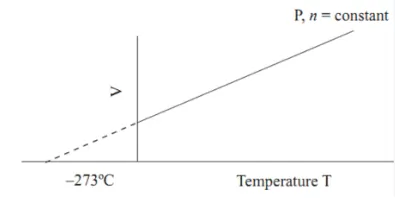
4.1 State the Charles' law related to gases and represent it graphically (V vs t)
Answer:

Charles' Law: At constant pressure, the volume of a fixed mass of gas is directly proportional to its absolute temperature.
Mathematically: \( V \propto T \) or \( \frac{V}{T} = \text{constant} \)

Graphical representation:
Concept: Gas Laws
4.2 How many grams of ammonium sulphate will be required to prepare 6.8g of ammonia by heating ammonium sulphate with caustic soda solution? (H=1, N=14, O=16, S=32)
Answer: 26.4 g
Solution
Reaction: \( (\text{NH}_4)_2\text{SO}_4 + 2\text{NaOH} \rightarrow \text{Na}_2\text{SO}_4 + 2\text{NH}_3 + 2\text{H}_2\text{O} \)
Molar mass of NH₃ = 14 + 1×3 = 17 g/mol
Molar mass of (NH₄)₂SO₄ = (14 + 1×4)×2 + 32 + 4×16 = 132 g/mol
From equation: 2 moles NH₃ (34g) from 1 mole (NH₄)₂SO₄ (132g)
For 6.8g NH₃, required (NH₄)₂SO₄ = \( \frac{132}{34} \times 6.8 = 26.4 \) g
Concept: Stoichiometry
4.2 (or) CaCl₂, CO₂ and H₂O are produced by the reaction of dilute HCl with CaCO₃. How many grams of HCl will be required to prepare 55.5g of CaCl₂, 22.2 g of CO₂ and 9.0 g of H₂O from 50.0g of CaCO₃? What is the number of mole of HCl required? [H=1, Cl=35.5]
Answer: 43.8g HCl, 1.2 moles
Solution:
Reaction: \( \text{CaCO}_3 + 2\text{HCl} \rightarrow \text{CaCl}_2 + \text{CO}_2 + \text{H}_2\text{O} \)
Molar mass HCl = (1 + 35.5) g/mol = 36.5 g/mol
From stoichiometry: 1 mole CaCO₃ \((=40+12+3 \times 16 =100g)\) requires 2 moles HCl \((2\times 36.5 = 73g)\)
For 50g CaCO₃, required HCl = \( \frac{73}{100} \times 50 = 36.5 \) g
But we need to produce specific amounts:
From 55.5g CaCl₂ (0.5 mole), we need 1 mole HCl = 36.5g
From 22.2g CO₂ (0.5 mole), we need 1 mole HCl = 36.5g
From 9.0g H₂O (0.5 mole), we need 1 mole HCl = 36.5g
Total HCl required = 36.5g
Moles of HCl = \( \frac{36.5}{36.5} = 1 \) mole
Concept: Stoichiometry
4.3 What is the volume expansion coefficient of a gas at a fixed pressure? What is its value?
Answer:
The volume expansion coefficient of a gas at constant pressure is \( \frac{1}{273} \) °C⁻¹. This means that for every 1°C rise in temperature, the volume of gas increases by \( \frac{1}{273} \) of its volume at 0°C.
Concept: Thermal Properties
4.3 (or) Mention two similarities between heat conduction and electrical conduction. Mention a non-metal having high thermal conductivity.
Answer:
Similarities between heat and electrical conduction:
1. Both follow similar mathematical equations (Fourier's law for heat, Ohm's law for electricity)
2. Both depend on material properties (thermal conductivity and electrical conductivity)

Non-metal with high thermal conductivity: Diamond has the highest thermal conductivity among non-metals (about 5 times that of copper).
Concept: Thermal Properties
4.4 State the two laws of refraction of light. Also write the mathematical formula of the second law.
Answer:
First Law of Refraction: The incident ray, the refracted ray, and the normal to the interface at the point of incidence all lie in the same plane.

Second Law of Refraction (Snell's Law): The ratio of the sine of the angle of incidence to the sine of the angle of refraction is constant for a given pair of media.
Mathematical formula: \( \frac{\sin i}{\sin r} = \text{constant} = \mu \)
Where \( \mu \) is the refractive index of the second medium with respect to the first medium.
Concept: Refraction of Light
4.5 In case of a concave mirror, find the relationship between focal length and radius of curvature.
Answer:
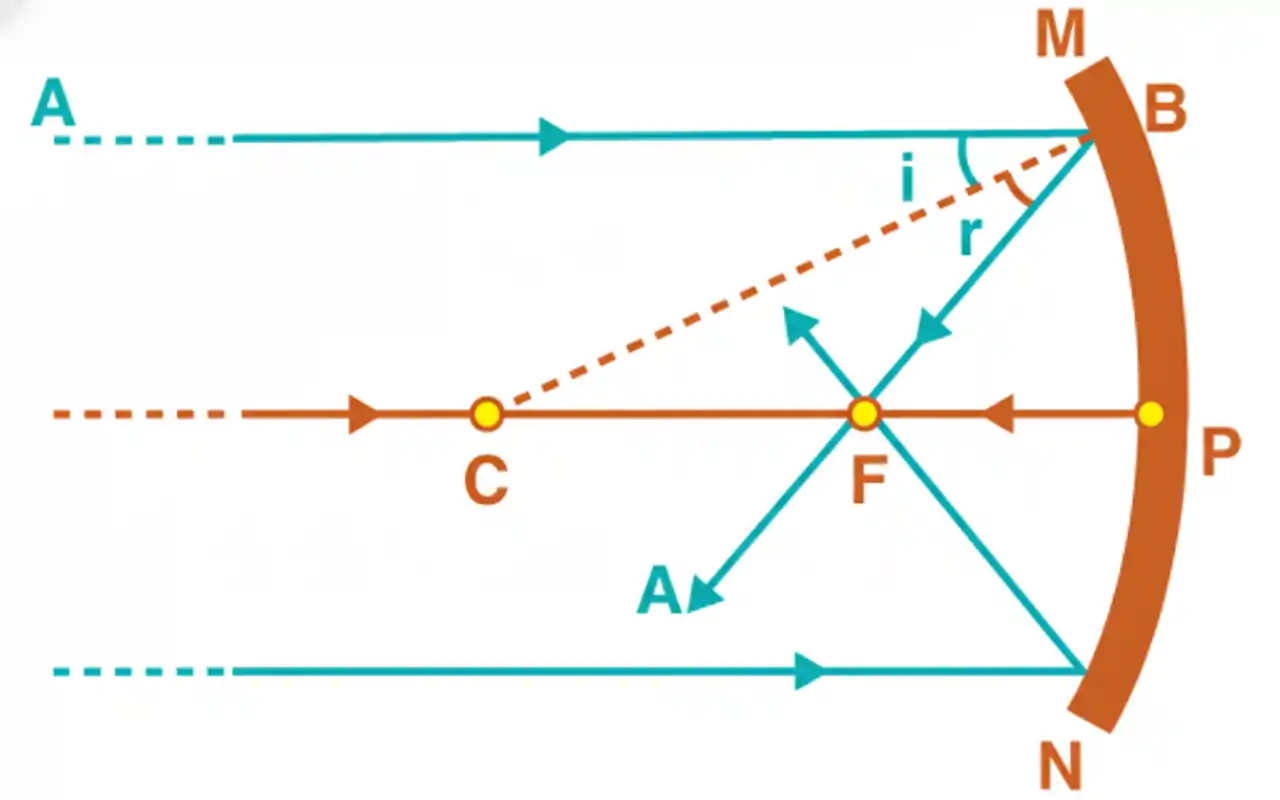
Concave mirror showing relationship between radius of curvature and focal length

A light ray AB strikes a spherical mirror at point B while being parallel to the principal axis. CB serves as the normal line to the surface at point B. The radius of curvature is denoted as CP = CB = R. After the light reflects off the mirror, it converges at the focus of the concave mirror F, following the law of reflection, which states that the angle of incidence equals the angle of reflection (i = r).

From the geometry of the figure,

∠BCP = θ = i (As ∠BCP and ∠ABC are alternate angles)

In ΔCBF, ∠CBF = θ = r

∴ BF = FC (because i = r)

If the aperture of the mirror is small, B lies close to P, and therefore BF = PF

=> FC = BF = PF

=> PC = PF + FC = PF + PF

=> R = 2 PF = 2f

=> f = R/2 (Hence Proved)

Concept: Geometrical Optics
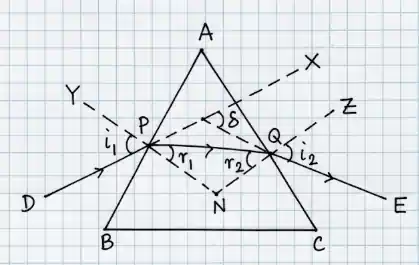
4.5 (or) A ray of light passes through a prism. Show the angle of deviation \( \delta = i_1 + i_2 - A \). (Symbols have usual meaning)
Answer:
deviation angle by prism
In quadrilateral APNQ: \( \angle A + \angle PNQ = 180^\circ \) ...(1)
In triangle PNQ: \( r_1 + r_2 + \angle PNQ = 180^\circ \) ...(2)
From (1) and (2): \( A = r_1 + r_2 \)
Angle of deviation: \( \delta = (i_1 - r_1) + (i_2 - r_2) \)
\( \delta = i_1 + i_2 - (r_1 + r_2) \)
\( \delta = i_1 + i_2 - A \)
Concept: Geometrical Optics
4.6 Write Faraday's laws of electromagnetic induction. What is meant by alternating current?
Answer:
Faraday's First Law: Whenever the magnetic flux linked with a circuit changes, an electromotive force (emf) is induced in the circuit. The induced emf lasts as long as the change in magnetic flux continues.

Faraday's Second Law: The magnitude of the induced emf is directly proportional to the rate of change of magnetic flux linked with the closed coil.
Mathematically: \( \epsilon = -N \frac{d\Phi}{dt} \)
Where \( \epsilon \) is induced emf, N is number of turns, and \( \frac{d\Phi}{dt} \) is rate of change of magnetic flux.

Alternating Current (AC): An electric current that periodically reverses direction and changes its magnitude continuously with time, in contrast to direct current (DC) which flows only in one direction.
Concept: Electromagnetic Induction
4.7 An electric bulb of resistance 440 ohm is connected to 220 volt mains for 10 hours. Find the amount of electrical energy consumed in BOT unit.
Answer:
Power, \( P = \frac{V^2}{R} = \frac{(220)^2}{440} = 110 \) W = 0.11 kW
Energy consumed = Power × Time = 0.11 kW × 10 h = 1.1 kWh (BOT unit)
Concept: Electrical Circuits
4.7 (or) A metal wire of resistance 6 ohm is stretched so that its length becomes double its original length. What would be the final resistance?
Answer:
Resistance, \( R = \rho \frac{l}{A} \)
When length becomes double (2l), volume remains constant, so area becomes half (A/2)
New resistance, \( R' = \rho \frac{2l}{A/2} = 4 \times \rho \frac{l}{A} = 4 \times 6 = 24 \) ohm
Concept: Electrical Circuits
4.8 What is meant by mass defect? What is the source of energy released in nuclear fusion?
Answer:
Mass Defect: The difference between the mass of an atomic nucleus and the sum of the masses of its constituent particles (protons and neutrons). This "missing" mass is converted into binding energy that holds the nucleus together.

Source of energy in nuclear fusion: In nuclear fusion, when light nuclei combine to form a heavier nucleus, the mass of the product nucleus is less than the sum of masses of the original nuclei. This mass defect is converted into energy according to Einstein's equation \( E = \Delta m c^2 \), where \( \Delta m \) is the mass defect and c is the speed of light.
Concept: Nuclear Physics
4.9 Write with an example what is meant by periodic property of elements? Mention a property which is not periodic.
Answer:
A periodic property is one that shows a regular pattern or trend across periods and down groups in the periodic table.
Example: Atomic radius decreases across a period (from left to right) and increases down a group.
Non-periodic property: Radioactivity is not a periodic property.
Concept: Periodic Table
4.9 (or) What is meant by electronegativity of an element? How does electronegativity of Group 1 elements of the long periodic table change from top to bottom?
Answer:
Electronegativity: The tendency of an atom in a molecule to attract the shared pair of electrons towards itself.
Trend in Group 1: Electronegativity decreases from top to bottom in Group 1 (alkali metals). This is because atomic size increases down the group, reducing the nucleus's ability to attract bonding electrons.
Concept: Periodic Table
4.10 Which energy is responsible for the chemical reaction to occur during electrolysis? What reactions do occur at the cathode and the anode during electrolysis of acidulated water?
Answer: Electrical energy; H₂ at cathode, O₂ at anode
Explanation:
Energy source: Electrical energy is responsible for the chemical reactions during electrolysis. It provides the necessary energy to drive non-spontaneous redox reactions.

Electrolysis of acidulated water (water with few drops of H₂SO₄):
At cathode (reduction): \( 2\text{H}^+ + 2e^- \rightarrow \text{H}_2 \uparrow \)
At anode (oxidation): \( 2\text{H}_2\text{O} \rightarrow \text{O}_2 \uparrow + 4\text{H}^+ + 4e^- \)
Overall reaction: \( 2\text{H}_2\text{O} \rightarrow 2\text{H}_2 \uparrow + \text{O}_2 \uparrow \)
Concept: Electrolysis
4.11 Write a balanced chemical equation with conditions for the industrial manufacture SO₃ from SO₂ by the contact process. How is H₂SO₄ prepared from the SO₃ produced?
Answer:
Manufacture of SO₃ from SO₂:
\( 2\text{SO}_2 + \text{O}_2 \xrightarrow[400-450^\circ\text{C}]{\text{V}_2\text{O}_5} 2\text{SO}_3 \)
Conditions: Temperature 400-450°C, Pressure 1.5-1.7 atm, Vanadium pentoxide (V₂O₅) catalyst

Preparation of H₂SO₄ from SO₃:
SO₃ is dissolved in 98% H₂SO₄ to form oleum (H₂S₂O₇):
\( \text{SO}_3 + \text{H}_2\text{SO}_4 \rightarrow \text{H}_2\text{S}_2\text{O}_7 \)
Oleum is then diluted with water to get concentrated H₂SO₄:
\( \text{H}_2\text{S}_2\text{O}_7 + \text{H}_2\text{O} \rightarrow 2\text{H}_2\text{SO}_4 \)
Concept: Industrial Chemistry
4.12 Write balanced chemical equation of addition reaction of hydrogen with acetylene mentioning the conditions of reaction. Mention one use of LPG.
Answer:
Addition of hydrogen to acetylene:
\( \text{HC} \equiv \text{CH} + \text{H}_2 \xrightarrow[\text{Ni catalyst}]{200-300^\circ\text{C}} \text{H}_2\text{C} = \text{CH}_2 \) (ethene)
\( \text{H}_2\text{C} = \text{CH}_2 + \text{H}_2 \xrightarrow[\text{Ni catalyst}]{200-300^\circ\text{C}} \text{CH}_3 - \text{CH}_3 \) (ethane)
Use of LPG: As domestic fuel for cooking and heating.
Concept: Organic Reactions & Polymers
4.12 (or) How do you convert CH₃CH₂OH to CH₂=CH₂? How is biopolymer protein biodegraded in nature?
Answer:
Conversion of ethanol to ethene:
\( \text{CH}_3\text{CH}_2\text{OH} \xrightarrow[\text{Conc. H}_2\text{SO}_4]{170^\circ\text{C}} \text{CH}_2 = \text{CH}_2 + \text{H}_2\text{O} \)
This is dehydration reaction (removal of water molecule).

Biodegradation of protein: Proteins are broken down by microorganisms through enzymatic hydrolysis into amino acids, which are further decomposed to simpler compounds like CO₂, H₂O, and NH₃.
Concept: Organic Reactions & Polymers

GROUP-E: For External Candidates

5.1 What is the main component of biogas?
Answer: Methane (CH₄)
Explanation: Biogas primarily consists of methane (50-75%), carbon dioxide (25-50%), and small amounts of other gases like hydrogen, nitrogen, and hydrogen sulfide. It is produced by anaerobic digestion of organic matter.
Concept: Fuels
5.2 What is the SI unit of electric charge?
Answer: Coulomb (C)
Explanation: The SI unit of electric charge is the coulomb (C). One coulomb is defined as the charge transported by a constant current of one ampere in one second. 1 C = 1 A × 1 s.
Concept: Electricity
5.3 How many elements are there in the third period of the long periodic table?
Answer: 8 elements
Explanation: The third period of the periodic table contains 8 elements: Sodium (Na), Magnesium (Mg), Aluminium (Al), Silicon (Si), Phosphorus (P), Sulfur (S), Chlorine (Cl), and Argon (Ar).
Concept: Periodic Table
5.4 What is the radioactive ray that is not made up of particles? What is the industrial source of CNG?
Answer: Gamma rays; Natural gas
Explanation:
Radioactive ray: Gamma rays are electromagnetic radiation, not particles. Alpha and beta rays consist of particles (helium nuclei and electrons respectively).

CNG source: Compressed Natural Gas (CNG) is obtained from natural gas fields. It is primarily methane (CH₄) compressed to less than 1% of its volume at standard atmospheric pressure.
Concept: Radioactivity & Fuels
6.1 What is the absolute scale of temperature?
Answer: Kelvin scale
Explanation: The absolute scale of temperature is the Kelvin scale, where 0 K (-273.15°C) is absolute zero - the theoretical lowest possible temperature where molecular motion ceases. The Kelvin scale has the same increment as Celsius scale but starts from absolute zero.
Concept: Temperature Scales
6.2 Mention two advantages of AC over DC.
Answer: 1. Easy voltage transformation 2. Lower transmission losses
Explanation:
1. Easy voltage transformation: AC voltage can be easily stepped up or down using transformers, enabling efficient long-distance transmission.
2. Lower transmission losses: At high voltages (used for transmission), AC has lower energy losses compared to DC.
Additional advantages: AC motors are simpler and cheaper, AC can be easily generated.
Concept: Alternating Current
6.3 Write with the balanced chemical equation what happens when an aqueous solution of ammonia is added to an aqueous solution of ferric chloride.
Answer: Forms reddish-brown precipitate
Explanation: When ammonia solution is added to ferric chloride solution, a reddish-brown precipitate of ferric hydroxide is formed:
\( \text{FeCl}_3 + 3\text{NH}_4\text{OH} \rightarrow \text{Fe(OH)}_3 \downarrow + 3\text{NH}_4\text{Cl} \)
The reddish-brown precipitate is insoluble ferric hydroxide [Fe(OH)₃].
Concept: Chemical Reactions
6.4 Write with the balanced chemical equation what happens when methane undergoes combustion in oxygen.
Answer: Complete combustion produces CO₂ and H₂O
Explanation: Methane undergoes complete combustion in excess oxygen to produce carbon dioxide and water vapor, releasing a large amount of heat:
\( \text{CH}_4 + 2\text{O}_2 \rightarrow \text{CO}_2 + 2\text{H}_2\text{O} + \text{Heat} \)
This is an exothermic reaction used in natural gas as fuel.
Concept: Combustion

Final Preparation Tips

Concept Clarity

Focus on understanding fundamental concepts rather than rote learning.

Time Management

Practice solving papers within the allotted time to improve speed.

Revision

Regular revision of important formulas and concepts is crucial.